

supporting and curating artistic practice
what is fluid
fluid ˈfluːɪd/ Floo-id
The word fluid originates from the Latin fluidus, meaning “flowing” or “moist,” itself derived from fluere, “to flow.”
It describes any substance capable of moving and assuming the shape of its container.
Although fluid art technically refers to an abstract painting technique—typically involving acrylic paints combined with a pouring medium to produce organic, abstract patterns—our understanding of the term expands beyond its physical definition toward a more metaphorical realm.
In fluid artistic practices, forms are understood as metamorphic identities, adaptable, and continually evolving.
They experiment and move beyond traditional binaries and disciplinary boundaries, transcending rigid distinctions between painting, architecture, and sculpture, as well as binary oppositions such as nature and culture, the organic and the artificial.
These forms are never fixed; instead, they remain in a perpetual state of becoming, occasionally captured at the brief moment of their solidification.
https://www.oed.com/dictionary/fluid_adj
what we do
*
what we do *
Fluid Art Forms is a hybrid platform based in Florence, Italy, dedicated to supporting both emerging and established artists working across a broad spectrum of media. Through the integration of writing and visual storytelling, it brings audiences closer to the heartbeat of contemporary art, amplifying artistic voices and illuminating their cultural impact.
Conceived as a nomadic, hybrid, and transcultural initiative, Fluid Art Forms brings together a diverse community of creative professionals—including artists, artisans, curators, writers, activists, and scholars. By nurturing cross-disciplinary collaboration and intercultural exchange, the project fosters experimentation, dialogue, and the sharing of knowledge. The result is a dynamic ecosystem where creativity, critical thought, and social engagement converge.
Mission & Values:
Fluid Art Forms is a hybrid platform that positions the visual arts as a catalyst for social change and democratic participation. By integrating artistic creation with local histories, archives, scientific research, and the humanities, we curate, support, and amplify underrepresented practices across physical and digital spaces. Grounded in accessibility and experimentation, Fluid Art Forms challenges rigid art-world structures—reactivating spaces, uncovering hidden narratives, and fostering critical reflection across diverse disciplines and communities.
We cultivate a nomadic and ever-evolving environment where the public can engage with visionary creatives and professionals, discovering the transformative potential of artistic expression. By transcending conventional boundaries of form, time, and space, we aim to foster inclusive settings that encourage exploration, dialogue, and imagination.
Goals:
Rather than fitting practices into existing power structures, our goal is to decentralize artistic discourse by centering voices that challenge established canons—both in Tuscany and internationally. We create spaces grounded in solidarity and shared agency, offering artists and researchers the tools, platforms, and connections required to flourish. By partnering with independent platforms, visual artists, and cultural organizations, we spark collaborative dialogues that reimagine the role of contemporary art in public life.
Operating across Florence, Berlin, and Poznań, Fluid Art Forms connects local artistic topographies with international dialogues. The platform supports artists working across diverse media by uniting critical writing, archival inquiry, and visual storytelling—making contemporary practice accessible while underscoring its capacity for civic and cultural transformation.
Aleksandra Lisek is an art critic, independent curator, researcher, and cultural project producer. She is the founder and director of Fluid Art Forms, a transdisciplinary platform dedicated to supporting underrepresented artistic practices, cross-cultural research, and spatial experimentation.
She holds degrees in Performing Arts from the Jagiellonian University in Krakow and a Master’s degree in Curating Visual Arts, Visual Culture, and Contemporary Art History from the Accademia di Belle Arti di Firenze. She also completed postgraduate studies in Art Law and Collecting at Sapienza University of Rome, along with specialized qualifications in Transcultural Mediation of Contemporary Cultural Heritage and Accessibility Policies in Modern Museology. Her theoretical and curatorial research centers on the decolonization of museum spaces, posthumanism, new materialisms, and the intersections between contemporary art, technology, and archives.
Currently, she works internationally in art criticism and institutional relations as Arts & Brand Partnership Representative & Editor at Contemporary Lynx Magazine, where she coordinates collaborations with leading global institutions, galleries, and platforms. Through her critical practice, she regularly participates in international press trips and curatorial study visits across Europe, analyzing global exhibition trends and building institutional networks.
Her professional background includes work with Bunkier Sztuki Gallery of Contemporary Art in Krakow, as well as Florentine institutions and foundations such as Fondazione Il Bisonte, Manifattura Tabacchi, Museo Novecento, and Fondazione Palazzo Strozzi.
As a curator, she develops research-driven projects, including the open-call winning exhibition Fabulazione / Fabulacja (Prato, 2023), which explored alternative narratives and posthuman subjects. Her critical essays, reviews, and academic texts appear in publications such as Contemporary Lynx, AICA International e-mag, Elementy. Sztuka i Dizajn, roots§routes, FUL Magazine, Exibart, and Juliet Art Magazine. She frequently presents at international scientific symposia on decolonial studies and institutional critique, and moderates panel discussions—recently hosting the panel “Who Gets Seen? Who Gets Remembered? Building an Artist’s Career in an Age of AI, Algorithms and Uncertainty” at ArtVilnius’26.


Exhibition: Fabulation
*
Exhibition: Fabulation *
featuring works by Simone Cariota, Maria Gomez, and Miguel Justicia
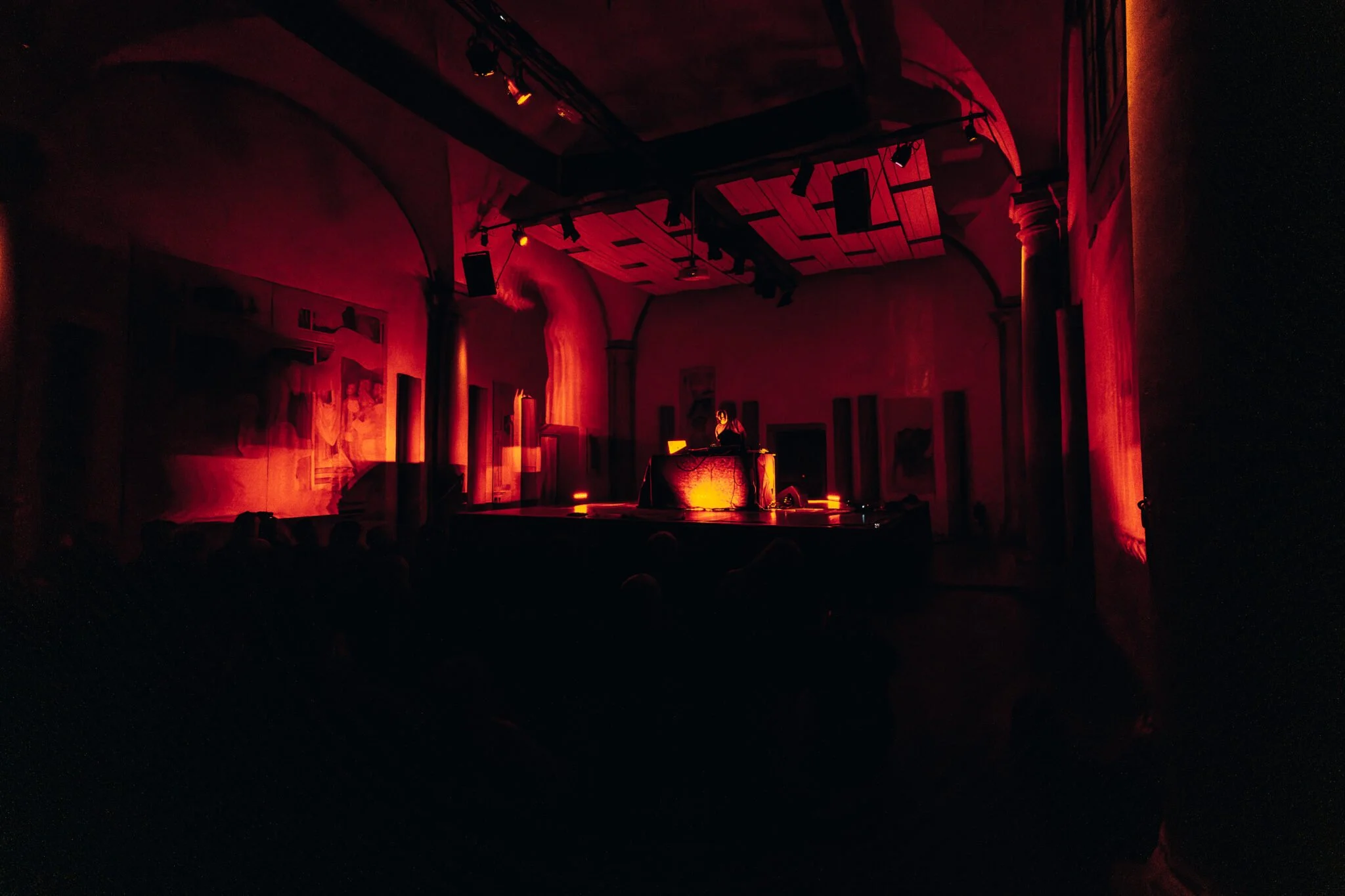
The exhibition Fabulation at Ex Macelli Freschi in Prato (2023), featuring works by Simone Cariota, Maria Gomez, and Miguel Justicia (Potro Negro), explores alternative narratives and metamorphic forms in contemporary art through immersive spaces combining sound and image in collaboration with Forme Arte, Fondazione Il Bisonte, and CUT-Circuito Urbano Contemporaneo in Prato, Italy.
The group exhibition aimed to immerse visitors in an uncertain and fluctuating space, exploring the potential of a possible alternative narrative through the construction of a space that engages the body in listening to sounds and observing unsystematic images.
Exhibition text:
The material birth of the story arises from living somewhere else. Our imagination needs veiled elements to re-signify the boundaries of the representable. In this sense, the creation of an acousmatic place that cannot be delineated through the gaze generates a new sensation to inhabit, making it possible to stay in an indeterminate space. The word “acousma” was born in Greek antiquity to describe the sounds we hear but are not exactly able to say where they come from. The acousmatic space can therefore be defined as a sound atmosphere that dictates the possibilities of new perceptive and physical knowledge. The intent of the exhibition is to immerse the visitor in this uncertain and fluctuating place, exploring the potential of a possible alternative narrative through the construction of a space that involves bodies in listening to sounds and observing images not systematized. The work of Maria Gomez and Miguel Justicia is constituted under the premise of learning to perceive from the radicality of the decomposition of meaning. Artists make a compromise with what the sensitive hides: seeing, hearing, touching and intuiting things in another way.They outline exercises that compose a broken perception by provoking a counter-sense, so that in non-existence the exceptional can happen.
Clairvoyance/foresight and epiphanies are caused by the emergence of new forms of the sensitive, of new buried relationships that our gaze discovers when it excavates landscapes.The volatile deformation of the forms developed by Simone Cariota seems to enter into dialogue with the flows of light and sound in space, which become integral elements of the process of modeling his forms. Cariota's chimerical figures, born from the combination of elements of human and animal nature, are created through thermo-forming on the basis of fragments of classical statues found in various places.
Distorted details of concave grooves and plastic protrusions are therefore part of a nomadic metamorphosis that resists a state of permanence. The meeting between these practices generates a new fabled space perceived as a mapped archive in which travellers, through a story emotionally intuited within, find connections between the visual and sound potential of the material found in the space. A place that leaves our vision in suspension to create a reality only imagined, open to the possibility of inhabiting a newly born land.
Support:
INVISITA workshop was organized by Cut | Temporary Urban Circuit and Contemporary Art Forms with the contribution of the Tuscany Region, Fondazione CR Firenze, Academy of Fine Arts of Florence and with the collaboration of the Municipality of Prato, Officina Giovani, TranSpace, Materiale Project Room, ABAFi Student Council and Fondazione Il Bisonte .

